Noticias
Secuenciación del primer genoma completo del virus del chikungunya del linaje ECSA en México
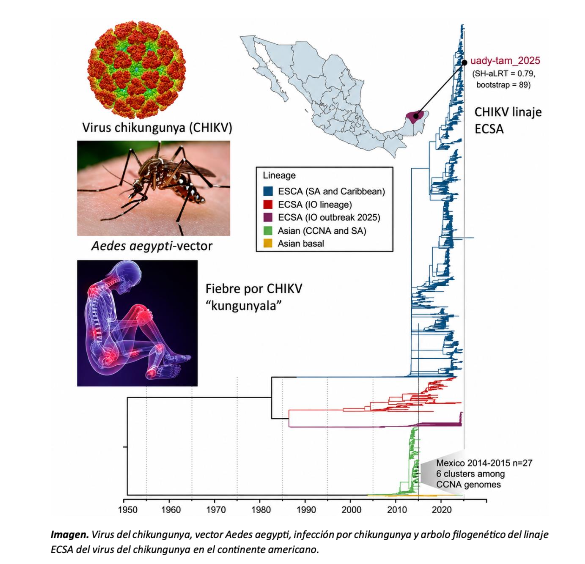
Investigadores
de la Universidad Autónoma de Yucatán (UADY) realizaron por primera vez en
México la secuenciación completa del genoma del virus del chikungunya (CHIKV)
del linaje Centro y Sureste Africano (East/Central/South African, ECSA), un
avance que fortalece la vigilancia genómica y el monitoreo de este virus en el
país.
El
estudio fue desarrollado por el Laboratorio de Virología del Centro de
Investigaciones Regionales "Dr. Hideyo Noguchi", como parte del
equipo EPICVAC-ARBO, liderado por el Dr. Henry Puerta-Guardo, en colaboración
con investigadores de la UNAM, universidades de Estados Unidos, elArbovirus
Research Collaborative Consortium (ARCC), la Secretaría de Salud de México, el CENAPRECE
y la Organización Panamericana de la Salud (OPS).
La
secuenciación se obtuvo a partir de una muestra clínica de un viajero que
presentó un síndrome febril al ingresar a México. El análisis permitió
confirmar la presencia del linaje ECSA y generar la primera secuencia de genoma
completo de este linaje registrado en el país. Para ello se empleó la tecnología
portátil MinION de Oxford Nanopore y herramientas bioinformáticas para el
análisis filogenético.
El
virus del chikungunya es transmitido por los mosquitos Aedes aegypti y Aedes
albopictus y provoca fiebre alta, dolor intenso en las articulaciones, dolor
muscular y cefalea. En algunos pacientes, el dolor articular puede persistir
durante meses o incluso años. Desde su introducción en América en 2013, el
virus se ha expandido ampliamente por la región. De acuerdo con la OPS, entre
2025 y 2026 se han registrado cerca de 500 mil casos sintomáticos asociados con
este linaje, mientras que en México la Secretaría de Salud ha confirmado
únicamente 31 casos, lo que resalta la importancia de fortalecer la vigilancia
genómica para detectar oportunamente la introducción y circulación de nuevos
linajes.
Este
primer genoma completo del linaje ECSA en México aporta información clave para
comprender la evolución y diversidad genética del virus, además de fortalecer
las estrategias de vigilancia epidemiológica, control vectorial y desarrollo de
nuevas herramientas para la prevención de la enfermedad. Con este logro, la
UADY reafirma su compromiso con la investigación científica de excelencia y
consolida al Centro de Investigaciones Regionales "Dr. Hideyo
Noguchi" como un referente nacional e internacional en el estudio de
arbovirus y enfermedades infecciosas emergentes.
Sequencing
of the First Complete Genome of the ECSA Lineage of Chikungunya Virus in Mexico
Researchers
at the Universidad Autónoma de Yucatán (UADY) led by Dr. Henry Puerta-Guardo,
in collaboration with researchers from the National Autonomous University of Mexico
(UNAM), universities in the United States, the Arbovirus Research Collaborative
Consortium (ARCC), Mexico's Ministry of Health, the National Center for
Preventive Programs and Disease Control (CENAPRECE), and the Pan American
Health Organization (PAHO) have, for the first time in Mexico, successfully
sequenced the complete genome of the East/Central/South African (ECSA) lineage
of the chikungunya virus (CHIKV). This achievement strengthens genomic
surveillance and monitoring of this virus in the country.
The
genome sequence was obtained from a clinical sample collected from a traveler
who developed a febrile illness upon entering Mexico. Analysis confirmed the
presence of the ECSA lineage and generated the first complete genome sequence
of this lineage reported in the country. The study employed Oxford Nanopore's
portable MinION sequencing technology along with bioinformatics tools for
phylogenetic analysis.
Chikungunya
virus is transmitted by Aedes aegypti and Aedes
albopictus mosquitoes and causes high fever, severe joint pain, muscle
pain, and headache. In some patients, joint pain may persist for months or even
years. Since its introduction into the Americas in 2013, the virus has spread
widely throughout the region. According to PAHO, nearly 500,000 symptomatic
cases associated with this lineage have been reported between 2025 and 2026, while
Mexico's Ministry of Health has confirmed only 31 cases. This highlights the importance
of strengthening genomic surveillance to enable the timely detection of the introduction
and circulation of new viral lineages.
This
first complete genome of the ECSA lineage in Mexico provides critical
information for understanding the virus's evolution and genetic diversity. It
also strengthens strategies for epidemiological surveillance, vector control,
and the development of new tools for disease prevention. Through this
achievement, UADY reaffirms its commitment to scientific excellence and further
establishes the "Dr. Hideyo Noguchi" Regional Research Center as a national
and international leader in the study of arboviruses and emerging infectious
diseases.